dimensionless-graph-laplacian → hertz
REFUSED unless mass and stiffness or another dimensional physical bridge are declared.
Shape & Resonance Lab 01 · 0-static-synthetic · DRAFT
Shape, vibration, energy, sound, and musical geometry without collapsed categories
Shape defines model-dependent possibilities and excitation selects motion; acoustic coupling would be required for a physical sound-pressure prediction, while this release provides declared sonification only; people and cultures may make music.
As of: 2026-08-26 · Next review due: 2027-08-26
Maintainer-authorized assisted construction; exact text has not been separately human-reviewed.
Every energy or power term is tied to the declared mechanical model and an SI unit; PCM amplitude, loudness, feeling, value, and metaphor are excluded.
| Term | Expression | Unit | Scope |
|---|---|---|---|
| kinetic-energy | T=(1/2) qdot^T M qdot | joule | Declared linear mechanical model only. |
| elastic-potential-energy | V=(1/2) q^T K q | joule | Declared linear mechanical model only. |
| total-mechanical-energy | E=T+V | joule | Conserved only when forcing and damping are absent under the declared model. |
| damping-power | P_d=qdot^T C qdot | watt | A nonnegative loss rate when C is positive semidefinite; it is not an energy store. |
| forcing-power | P_f(t)=eta_dot*Q(t)=eta_dot*Q0*cos(Omega*t) | watt | Signed instantaneous mechanical power supplied to the declared driven scalar mode; Q0 is the generalized-force amplitude. |
| pcm-amplitude-is-not-energy | PCM code != joule | pcm16 | Digital sample amplitude is a declared sonification control and carries no mechanical-energy unit. |
REFUSED unless mass and stiffness or another dimensional physical bridge are declared.
REFUSED: v0.1 supplies no acoustic coupling, propagation medium, receiver, or pressure calibration.
REFUSED: no calibration maps mechanical energy to sample code.
REFUSED in this artifact; any perceptual hypothesis would require declared stimuli, listeners, tasks, models, and contexts.
REFUSED without a contextual perceptual and cultural study.
REFUSED: arithmetic evenness is not a cultural or aesthetic ranking.
Exhibit 1 · spectral mechanics and forced linear response
When does a dimensionless graph mode acquire hertz, and when may a model call its response resonant?
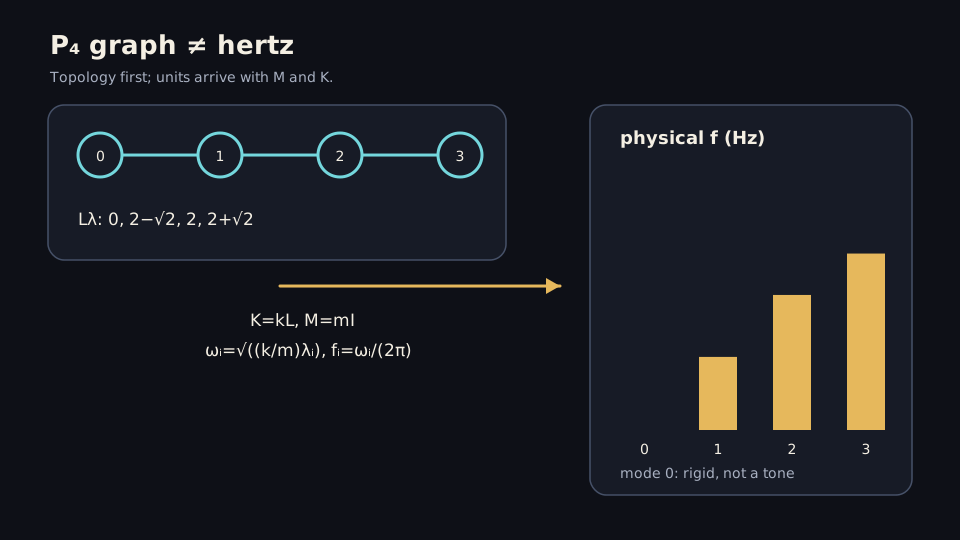
| Quantity | Value | Unit | Status | Meaning |
|---|---|---|---|---|
| Equal spring stiffness k | 6400 approx. 6400 | newton-per-metre | physical-model | Introduces force-per-displacement units. |
| Equal point mass m | 0.01 approx. 0.01 | kilogram | physical-model | Introduces inertia. |
| Driven mode natural angular frequency | 800*sqrt(2) approx. 1131.370849898 | radian-per-second | physical-model | For the normalized lambda=2 eigenvector. |
| Driven mode natural frequency | 400*sqrt(2)/pi approx. 180.063263231 | hertz | numerical-approximation | Cycles per second obtained by exact division by 2π before numerical display. |
| Aligned modal force amplitude F0=Q0 | 0.1 approx. 0.1 | newton | physical-model | The vector f0=F0*phi has zero component sum while generalized-force amplitude Q0=phi^T f0=F0 is nonzero. |
| Driven modal damping coefficient | 2*0.05*0.01*800*sqrt(2) approx. 1.13137085 | newton-second-per-metre | physical-model | Viscous modal damping c=2*zeta*m*omega_n. |
| Displacement-response peak ratio Omega_peak/omega_n | sqrt(1-2*zeta^2)=sqrt(0.995) approx. 0.997496867 | dimensionless | exact-mathematical | Valid for zeta<1/sqrt(2). |
| Steady-state modal displacement amplitude at analytic peak | 0.00007822284 approx. 0.00007822284 | metre | numerical-approximation | Synthetic model response, not a measurement. |
| Bridge | Expression | Status | Assumptions | Result / unit | Caveat |
|---|---|---|---|---|---|
| laplacian-to-physical-operator | K=kL and M=mI | physical-model |
| omega_i=sqrt((k/m)*lambda_i) / radian-per-second | Without k and m, lambda has no hertz interpretation. |
| angular-to-cyclic-frequency | f_i=omega_i/(2*pi) | exact-mathematical |
| modal cycles per second / hertz | A numerical decimal uses pi approximation only for display. |
| driven-steady-state-response | A(Omega)=Q0/sqrt((k*lambda-m*Omega^2)^2+(c*Omega)^2) | physical-model |
| displacement amplitude sweep / metre | The sweep is calculated; no experiment or measurement occurred. |
| driven-phase | delta(Omega)=atan2(c*Omega,k*lambda-m*Omega^2) | physical-model |
| phase lag crosses 90 degrees at Omega=omega_n / dimensionless | Phase angle is displayed in degrees, not a unit of energy or frequency. |
| orthogonal-drive-falsifier | Q=phi^T f0=0 for any drive vector orthogonal to phi | exact-mathematical |
| no forced response in the lambda=2 mode even when Omega=omega_n / newton | Frequency proximity without nonzero coupling is insufficient; this is why the aligned drive is called zero-net-spatial-force, not net-zero modal drive. |
| mechanical-energy-balance | d((1/2)m*eta_dot^2+(1/2)k*lambda*eta^2)/dt = eta_dot*Q0*cos(Omega*t)-c*eta_dot^2 | physical-model |
| instantaneous forcing power minus damping power / watt | This is a model balance, not an observed ledger. |
| structure-to-sound-pressure | structural motion -> acoustic pressure | no-canonical-conversion |
| REFUSED / not-applicable | The release supplies declared sonification only. |
| mode | Laplacian eigenvalue | exact omega rad/s | approx omega rad/s | approx frequency Hz | classification |
|---|---|---|---|---|---|
| 0 | 0 | 0 | 0.000000000 | 0.000000000 | rigid translation; excluded from audio |
| 1 | 2-sqrt(2) | 800*sqrt(2-sqrt(2)) | 612.293491784 | 97.449535840 | elastic mode; included in declared sonification |
| 2 | 2 | 800*sqrt(2) | 1131.370849898 | 180.063263231 | elastic mode; included in declared sonification |
| 3 | 2+sqrt(2) | 800*sqrt(2+sqrt(2)) | 1478.207252018 | 235.263991073 | elastic mode; included in declared sonification |
| drive ratio Omega/omega_n | drive frequency Hz | displacement amplitude m | phase lag degrees | marker |
|---|---|---|---|---|
| 0.500000 | 90.031631616 | 1.039359539e-5 | 3.814075 | sweep point |
| 0.800000 | 144.050610585 | 2.118461502e-5 | 12.528808 | sweep point |
| 0.950000 | 171.060100070 | 5.739019136e-5 | 44.255941 | sweep point |
| sqrt(1-2*zeta^2) | 179.612540964 | 7.822283974e-5 | 87.130424 | analytic displacement peak |
| 1.000000 | 180.063263231 | 7.812500000e-5 | 90.000000 | natural-frequency phase crossing |
| 1.050000 | 189.066426393 | 5.324212841e-5 | 134.309723 | sweep point |
| 1.200000 | 216.075915878 | 1.713003944e-5 | 164.744881 | sweep point |
| 1.500000 | 270.094894847 | 6.205480241e-6 | 173.157227 | sweep point |
A graph spectrum acquires angular-frequency units only through a declared M,K physical model. Under the separately declared force, coupling, damping, response observable, and sweep, the lambda=2 scalar model has an analytic displacement-response peak and a 90-degree phase crossing.
Changing m, k, boundary anchoring, damping, drive shape, or response observable changes the modal frequencies or response peak. An orthogonal drive has Q=0 and produces no forced response in this mode even at omega_n; with c=0, exact-frequency forcing has no bounded steady-state amplitude.
Scope: Finite, linear, equal-mass, equal-spring synthetic model only.
The label applies only to the deterministic damped-forced model calculation; no physical system was driven or measured.
No audio is requested on page load. Each ordinary same-origin WAV link makes a request only if a reader activates it; the browser may download, open, or play the file. The page has no embedded audio control. WAV access is never an acoustic prediction.
A half-second integer-triangle mix controlled by the three non-rigid frequencies of the declared P4 mass-spring model.
sha256:7ce6187a0396e7108102e4dffa8a8ae26b090f8bd3d67de37312c96dd7c5f556sha256:bb90706034760906cc62527c8baa80eb4083cc25c6eb7438d5a9b8a365436634Carrier/sampling declaration: Physical modal targets f=ω/(2π): 97.449535840, 180.063263231, 235.263991073 Hz. Integer phase increments 52317821, 96670728, 126306393 produce actual digital carrier fundamentals 97.449535504, 180.063262582, 235.263990238 Hz, with errors -3.365e-7, -6.496e-7, -8.347e-7 Hz. This is a sonification, not radiated pressure.
Spectrum caveat: The three listed values are carrier fundamentals, not the complete WAV spectrum. Triangle oscillators add odd harmonics; finite duration and the 320-frame envelope add window leakage and sidebands.
Complete non-audio equivalent: The public snapshot contains the complete schedule, equations, units, tables, and relation that generated this file.
Exhibit 2 · one-dimensional wave equation
Can equal length and wave speed still produce different allowed frequencies?
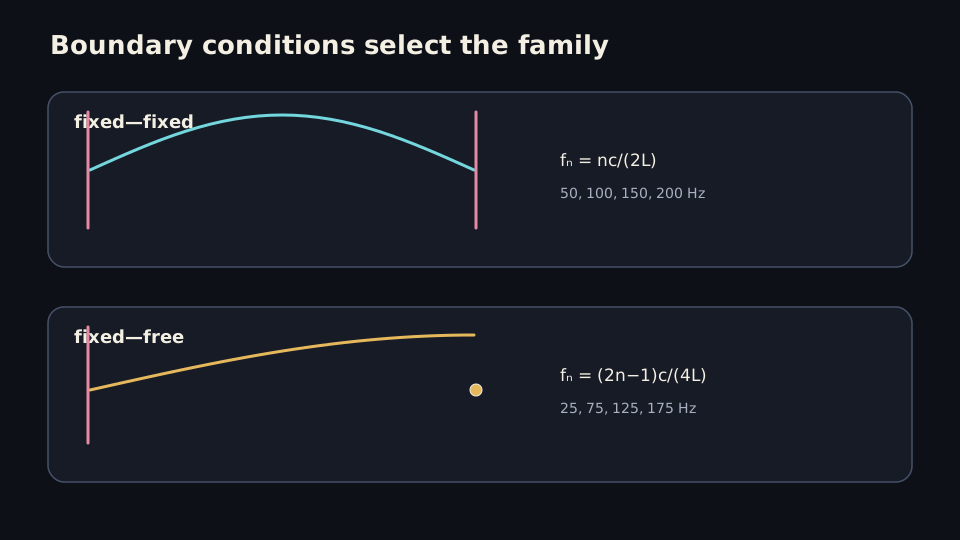
| Quantity | Value | Unit | Status | Meaning |
|---|---|---|---|---|
| Length L | 1 approx. 1 | metre | physical-model | Held equal. |
| Wave speed c | 100 approx. 100 | metre-per-second | physical-model | Held equal. |
| Bridge | Expression | Status | Assumptions | Result / unit | Caveat |
|---|---|---|---|---|---|
| fixed-fixed-family | f_n=n*c/(2L) | exact-mathematical |
| integer harmonic family / hertz | Ideal linear string. |
| fixed-free-family | f_n=(2n-1)*c/(4L) | exact-mathematical |
| odd-quarter-wave family / hertz | Ideal linear string. |
| boundary | n | exact expression | frequency Hz |
|---|---|---|---|
| fixed-fixed | 1 | 1*c/(2L) | 50 |
| fixed-fixed | 2 | 2*c/(2L) | 100 |
| fixed-fixed | 3 | 3*c/(2L) | 150 |
| fixed-fixed | 4 | 4*c/(2L) | 200 |
| fixed-free | 1 | (2*1-1)*c/(4L) | 25 |
| fixed-free | 2 | (2*2-1)*c/(4L) | 75 |
| fixed-free | 3 | (2*3-1)*c/(4L) | 125 |
| fixed-free | 4 | (2*4-1)*c/(4L) | 175 |
Boundary conditions select different admissible mode families even when interval length and wave speed are equal.
Replacing the fixed-free derivative condition with a second fixed displacement condition returns the fixed-fixed family.
Scope: Ideal one-dimensional small-displacement wave equation.
Exhibit 3 · partial differential operators on a square
Does a shared square outline determine the frequency law?
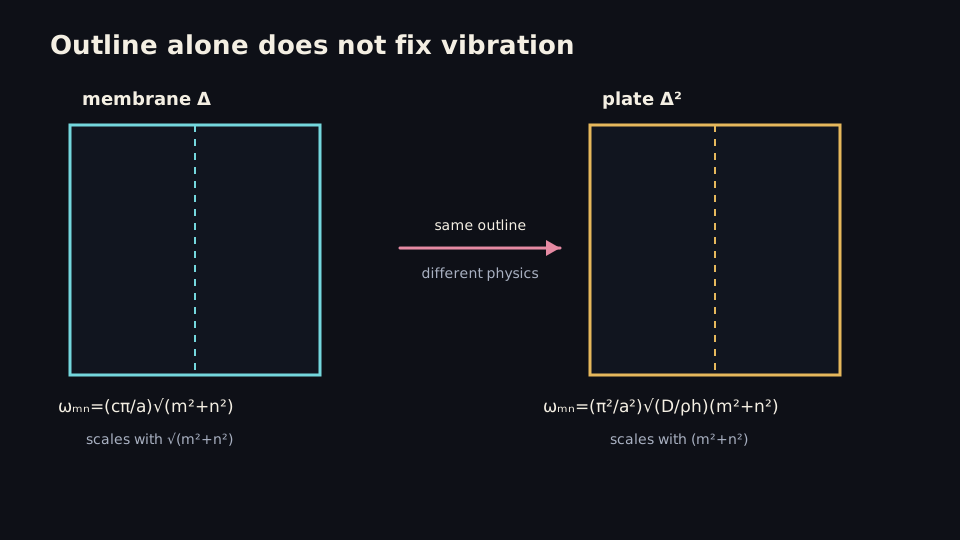
| Quantity | Value | Unit | Status | Meaning |
|---|---|---|---|---|
| Square side a | 1 approx. 1 | metre | physical-model | Held equal as outline only. |
| Membrane c | 100 approx. 100 | metre-per-second | physical-model | Membrane parameter. |
| Plate sqrt(D/(rho*h)) | 10 approx. 10 | square-metre-per-second | physical-model | Thin-plate parameter. |
| Bridge | Expression | Status | Assumptions | Result / unit | Caveat |
|---|---|---|---|---|---|
| membrane-frequency | f_mn=(c/(2a))*sqrt(m^2+n^2) | physical-model |
| square-root spectral scaling / hertz | Not a plate law. |
| plate-frequency | f_mn=(pi*beta/(2a^2))*(m^2+n^2) | physical-model |
| linear-in-eigenvalue scaling / hertz | Not a membrane law. |
| mode | m^2+n^2 | membrane exact Hz | membrane approx Hz | plate exact Hz | plate approx Hz |
|---|---|---|---|---|---|
| (1,1) | 2 | 50*sqrt(2) | 70.710678119 | 5*pi*2 | 31.415926536 |
| (1,2) | 5 | 50*sqrt(5) | 111.803398875 | 5*pi*5 | 78.539816340 |
| (2,2) | 8 | 50*sqrt(8) | 141.421356237 | 5*pi*8 | 125.663706144 |
The same outline and even the same sinusoidal labels can sit under different operators and frequency scalings.
Changing the operator from -Delta to Delta^2 changes sqrt(m^2+n^2) scaling to (m^2+n^2) scaling under the declared models.
Scope: Comparison of two ideal linear PDE fixtures.
Exhibit 4 · symmetry and eigenspace geometry
What does a repeated eigenvalue leave undetermined?
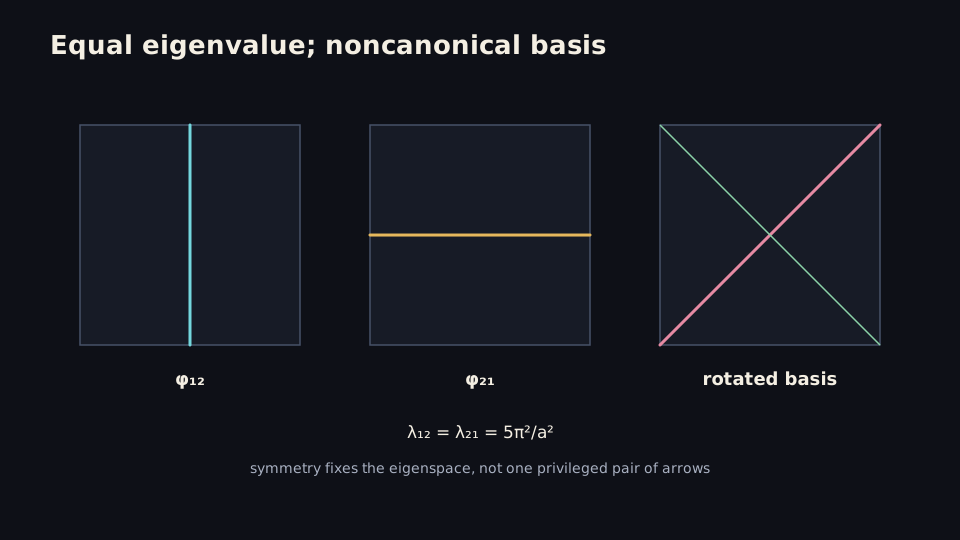
| Quantity | Value | Unit | Status | Meaning |
|---|---|---|---|---|
| Shared spatial eigenvalue lambda_12=lambda_21 | 5*pi^2/a^2 approx. 49.348022005 | inverse-square-metre | numerical-approximation | Multiplicity two on the perfect square. |
| Eigenspace dimension | 2 approx. 2 | dimensionless | exact-mathematical | Spanned by phi_12 and phi_21. |
| Bridge | Expression | Status | Assumptions | Result / unit | Caveat |
|---|---|---|---|---|---|
| basis-rotation | psi_1=cos(theta)*phi_12+sin(theta)*phi_21; psi_2=-sin(theta)*phi_12+cos(theta)*phi_21 | exact-mathematical |
| another orthonormal eigenbasis for every theta / dimensionless | A perturbation or measurement convention may select a basis, but the unperturbed operator does not. |
| member | formula | eigenvalue | canonical? |
|---|---|---|---|
| phi_12 | sin(pi*x/a) sin(2*pi*y/a) | 5*pi^2/a^2 | no; basis member |
| phi_21 | sin(2*pi*x/a) sin(pi*y/a) | 5*pi^2/a^2 | no; basis member |
| rotated pair | orthogonal theta rotation | same | no; equally valid basis |
A repeated eigenvalue identifies a multidimensional invariant subspace; it does not canonically name individual basis vectors inside that subspace.
Any nontrivial orthogonal rotation of phi_12 and phi_21 gives a different basis with the same eigenvalue, directly refuting basis uniqueness.
Scope: Exact square symmetry under the declared membrane operator.
Exhibit 5 · finite inverse spectral counterexample
Does an exact spectrum uniquely identify every finite connected graph?
| Quantity | Value | Unit | Status | Meaning |
|---|---|---|---|---|
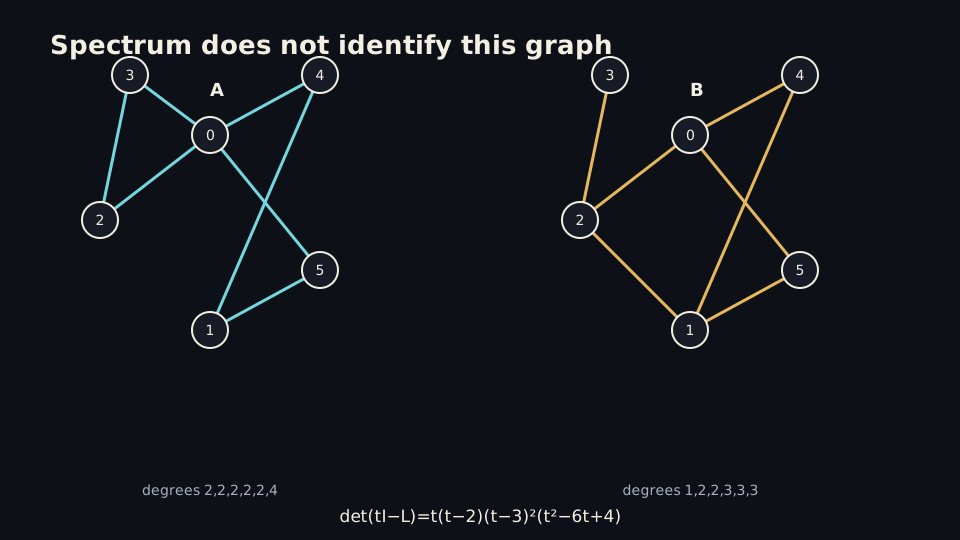
| Shared characteristic polynomial | t(t-2)(t-3)^2(t^2-6t+4) | dimensionless | exact-mathematical | Coefficient vector [1,-14,73,-176,192,-72,0]. |
| Shared sorted Laplacian spectrum | [0,3-sqrt(5),2,3,3,3+sqrt(5)] | dimensionless | exact-mathematical | Eigenvalue 3 has multiplicity two. |
| Graph A sorted degrees | [2,2,2,2,2,4] | dimensionless | exact-mathematical | Degree multiset is an isomorphism invariant. |
| Graph B sorted degrees | [1,2,2,3,3,3] | dimensionless | exact-mathematical | Different from Graph A. |
| Bridge | Expression | Status | Assumptions | Result / unit | Caveat |
|---|---|---|---|---|---|
| exact-characteristic-polynomial | Faddeev-LeVerrier over BigInt traces of L^k | exact-mathematical |
| [1,-14,73,-176,192,-72,0] / dimensionless | The producer recomputes both graphs independently. |
| non-isomorphism-witness | degreeMultiset(A) != degreeMultiset(B) | exact-mathematical |
| graphs are non-isomorphic / dimensionless | This witness does not depend on drawing layout. |
| graph | edges | sorted degrees | connected | det(tI-L) coefficients |
|---|---|---|---|---|
| A | [[0,2],[0,3],[0,4],[0,5],[1,4],[1,5],[2,3]] | [2,2,2,2,2,4] | true | [1,-14,73,-176,192,-72,0] |
| B | [[0,2],[0,4],[0,5],[1,2],[1,4],[1,5],[2,3]] | [1,2,2,3,3,3] | true | [1,-14,73,-176,192,-72,0] |
The pair falsifies the universal proposition that a connected finite simple graph is uniquely determined by its combinatorial-Laplacian spectrum.
Equal exact characteristic polynomials establish equal spectra, while unequal degree multisets prove non-isomorphism.
Scope: Finite combinatorial Laplacian only; Kac and Gordon-Webb-Wolpert are separate continuum context links.
Exhibit 6 · finite discrete Fourier phase counterexample
Can two different real finite waveforms have exactly equal DFT magnitudes?
| Quantity | Value | Unit | Status | Meaning |
|---|---|---|---|---|
| Sample rate | 8000 approx. 8000 | hertz | declared-sonification | Digital sampling convention. |
| Frames per file | 4000 approx. 4000 | sample | exact-mathematical | Duration 0.5 second. |
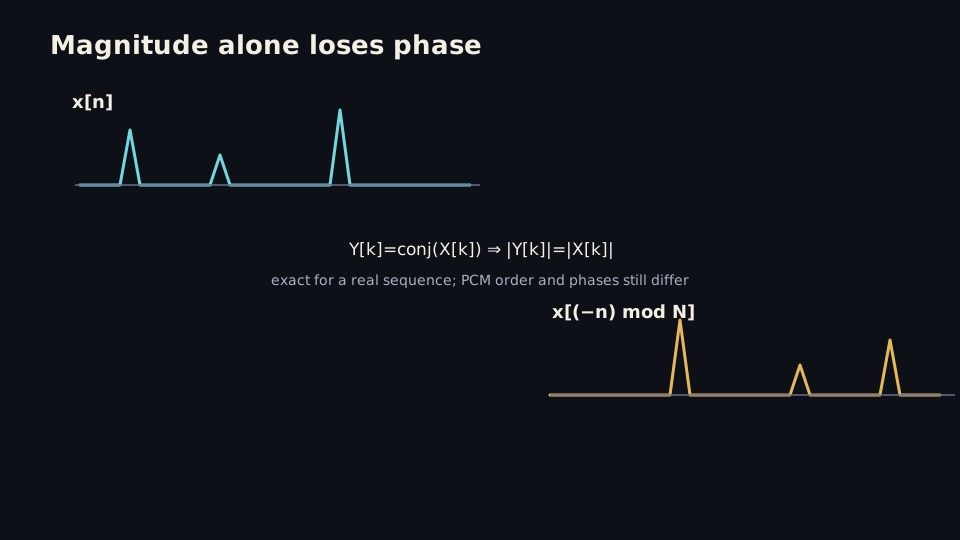
| Real cyclic reversal | y[0]=x[0]; y[n]=x[N-n] | dimensionless | exact-mathematical | Ensures Y[k]=conj(X[k]). |
| Bridge | Expression | Status | Assumptions | Result / unit | Caveat |
|---|---|---|---|---|---|
| reversal-dft | Y[k]=sum_n x[-n] exp(-i2*pi*k*n/N)=conj(X[k]) for real x | exact-mathematical |
| |Y[k]|=|X[k]| for every k / dimensionless | The theorem concerns the finite PCM sequence, not an analogue signal outside the file. |
| pcm-to-pressure | PCM16 code -> pascal | no-canonical-conversion |
| REFUSED / not-applicable | Playback hardware may produce sound, but the artifact predicts no pressure field. |
| start sample | length samples | triangle period samples | target peak PCM code | phase offset samples | carrier Hz |
|---|---|---|---|---|---|
| 200 | 400 | 80 | 10000 | 0 | 100 |
| 900 | 550 | 50 | 7500 | 7 | 160 |
| 1700 | 300 | 40 | 12000 | 13 | 200 |
| 2800 | 600 | 32 | 9000 | 3 | 250 |
For a real sequence, cyclic time reversal conjugates every DFT coefficient, preserving every magnitude while changing phases and, for this nonsymmetric fixture, sample order.
The producer verifies the two PCM blocks are unequal and satisfy y[n]=x[-n mod N] sample by sample; the displayed algebra then forces magnitude equality.
Scope: Finite N=4000 real PCM sequence and its cyclic DFT.
No audio is requested on page load. Each ordinary same-origin WAV link makes a request only if a reader activates it; the browser may download, open, or play the file. The page has no embedded audio control. WAV access is never an acoustic prediction.
A half-second schedule of four integer-triangle tone bursts.
sha256:157389bd7321f81c47a870d4895ddf4ae8c824f87baee8af03bfa769428f57b5sha256:1df5ac6f7375c16bccf1a1fa416a6cebde450927bce88b1534dbd5f316c5f227Carrier/sampling declaration: Each integer-triangle burst period maps to sampleRate/period: 100 Hz, 160 Hz, 200 Hz, 250 Hz. These are authored digital carriers, not physical modes.
Spectrum caveat: The listed rates are carrier fundamentals, not complete spectra. Triangle carriers contain odd harmonics and each finite 80-frame edge envelope produces sidebands and finite-window leakage.
Complete non-audio equivalent: The public snapshot contains the complete schedule, equations, units, tables, and relation that generated this file.
The exact cyclic sample reversal of phase-forward.wav; its DFT magnitudes are equal and phases conjugated.
sha256:db2a43b42f37c6feb3876bb085e2868f68d976e904fc4110a82ef0e4199638f4sha256:89609bbd464e1a0934275bc0b86bef66e91aec422a954b5561e86877aede29ddCarrier/sampling declaration: Each integer-triangle burst period maps to sampleRate/period: 100 Hz, 160 Hz, 200 Hz, 250 Hz. These are authored digital carriers, not physical modes.
Spectrum caveat: The listed rates are carrier fundamentals, not complete spectra. Triangle carriers contain odd harmonics and each finite 80-frame edge envelope produces sidebands and finite-window leakage.
Complete non-audio equivalent: The public snapshot contains the complete schedule, equations, units, tables, and relation that generated this file.
Exhibit 7 · bounded mathematical music theory
What does a one-semitone path mean, and what does it not mean?
| Quantity | Value | Unit | Status | Meaning |
|---|---|---|---|---|
| Octave size in this convention | 12 approx. 12 | semitone-12tet | exact-mathematical | Defines p~p+12. |
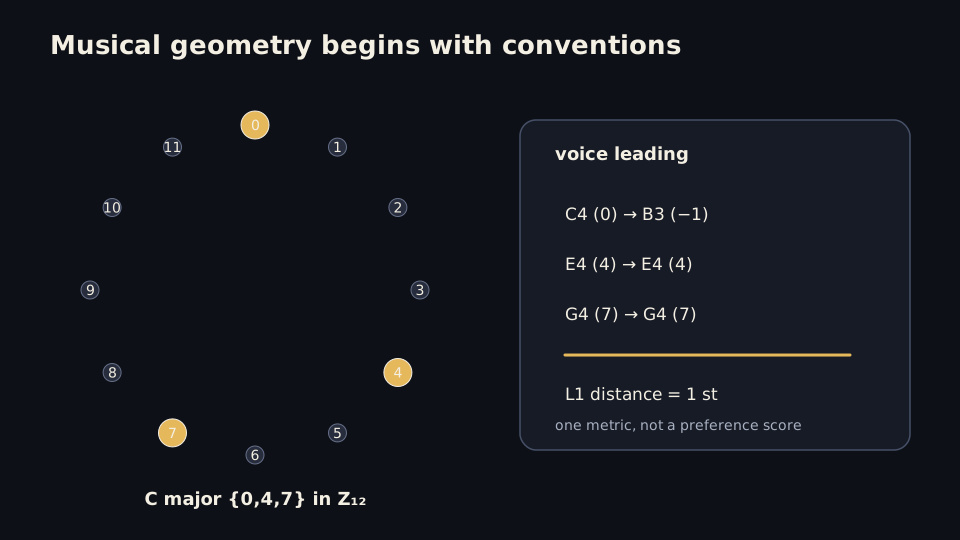
| Declared minimum L1 path | |0-(-1)|+|4-4|+|7-7|=1 approx. 1 | semitone-12tet | exact-mathematical | C major [0,4,7] to E minor [-1,4,7]. |
| Bridge | Expression | Status | Assumptions | Result / unit | Caveat |
|---|---|---|---|---|---|
| pitch-to-pitch-class | pc(p)=p mod 12 | exact-mathematical |
| cyclic pitch-class coordinate / cycle-index | Other tuning systems require another space. |
| voice-leading-distance | min over declared bijections and octave representatives of sum_i |p_i-q_sigma(i)| | exact-mathematical |
| distance 1 for the fixture / semitone-12tet | Another equivalence relation or metric can change the result. |
| distance-to-preference | short voice-leading distance -> preferred or consonant | no-canonical-conversion |
| REFUSED / not-applicable | Mathematical proximity is not an aesthetic verdict. |
| source voice | target representative | signed move st | absolute move st |
|---|---|---|---|
| C4 / 0 | B3 / -1 | -1 | 1 |
| E4 / 4 | E4 / 4 | 0 | 0 |
| G4 / 7 | G4 / 7 | 0 | 0 |
| total | under declared bijection | vector [-1,0,0] | 1 |
Chord and voice-leading geometry is well-defined only after equivalence relations, register choices, and a metric are declared.
Changing the metric, tuning lattice, chord equivalence, cardinality rule, or register window can change the nearest path.
Scope: One explicit Western 12-TET equal-cardinality L1 convention.
Exhibit 8 · finite cyclic rhythm geometry
How can five onsets be compared on a sixteen-step cycle?
| Quantity | Value | Unit | Status | Meaning |
|---|---|---|---|---|
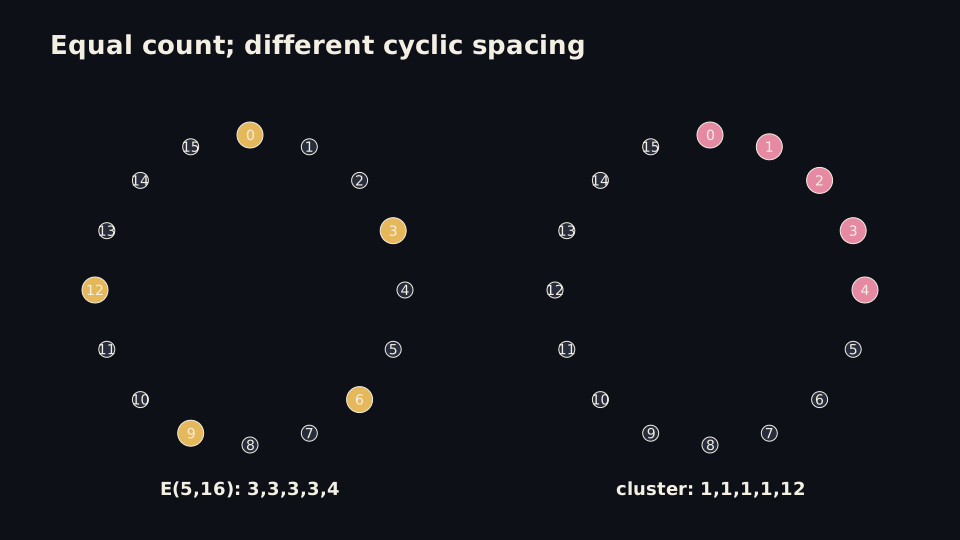
| Onsets in each pattern | 5 approx. 5 | dimensionless | exact-mathematical | Cardinality held equal. |
| Population variance of gaps [3,3,3,3,4] | 4/25 approx. 0.16 | dimensionless | exact-mathematical | Mean gap 16/5. |
| Population variance of gaps [1,1,1,1,12] | 484/25 approx. 19.36 | dimensionless | exact-mathematical | Mean gap 16/5. |
| Bridge | Expression | Status | Assumptions | Result / unit | Caveat |
|---|---|---|---|---|---|
| onsets-to-gaps | sorted cyclic differences including wraparound | exact-mathematical |
| E gaps [3,3,3,3,4]; cluster gaps [1,1,1,1,12] / cycle-index | Rotation changes the sequence start but not the gap multiset. |
| evenness-to-aesthetic | lower gap variance -> musically better or universal | no-canonical-conversion |
| REFUSED / not-applicable | Even spacing is a combinatorial property only. |
| pattern | onset set | cyclic gaps | gap variance | interpretation |
|---|---|---|---|---|
| Euclidean fixture E(5,16) | [0,3,6,9,12] | [3,3,3,3,4] | 4/25 | more even under declared gap variance |
| clustered contrast | [0,1,2,3,4] | [1,1,1,1,12] | 484/25 | less even under declared gap variance |
A cyclic onset set can be compared by exact gap structure under a declared convention.
Both patterns have five onsets yet have unequal exact gap variances, while neither arithmetic result supplies an aesthetic ordering.
Scope: Finite Z_16 onset-only comparison.
Titles, publishers, URLs, and checked-on dates orient a reader. They are not imported evidence bodies or permissions. No external resource is embedded or requested on page load; activating a source link may navigate to and request the named external origin under that origin's policies.
No source is embedded or requested on page load. Each external HTTPS link carries rel=noreferrer; activating one may navigate to and request that named origin under its own policies.